Quick answer: AI is unlikely to replace interior designers as a profession. It will replace or compress parts of the workflow, especially early concept generation, style exploration, image editing, and repetitive presentation work. Designers remain responsible for understanding clients, measuring real spaces, specifying materials, coordinating trades, managing budgets, and making safe decisions that can be built.
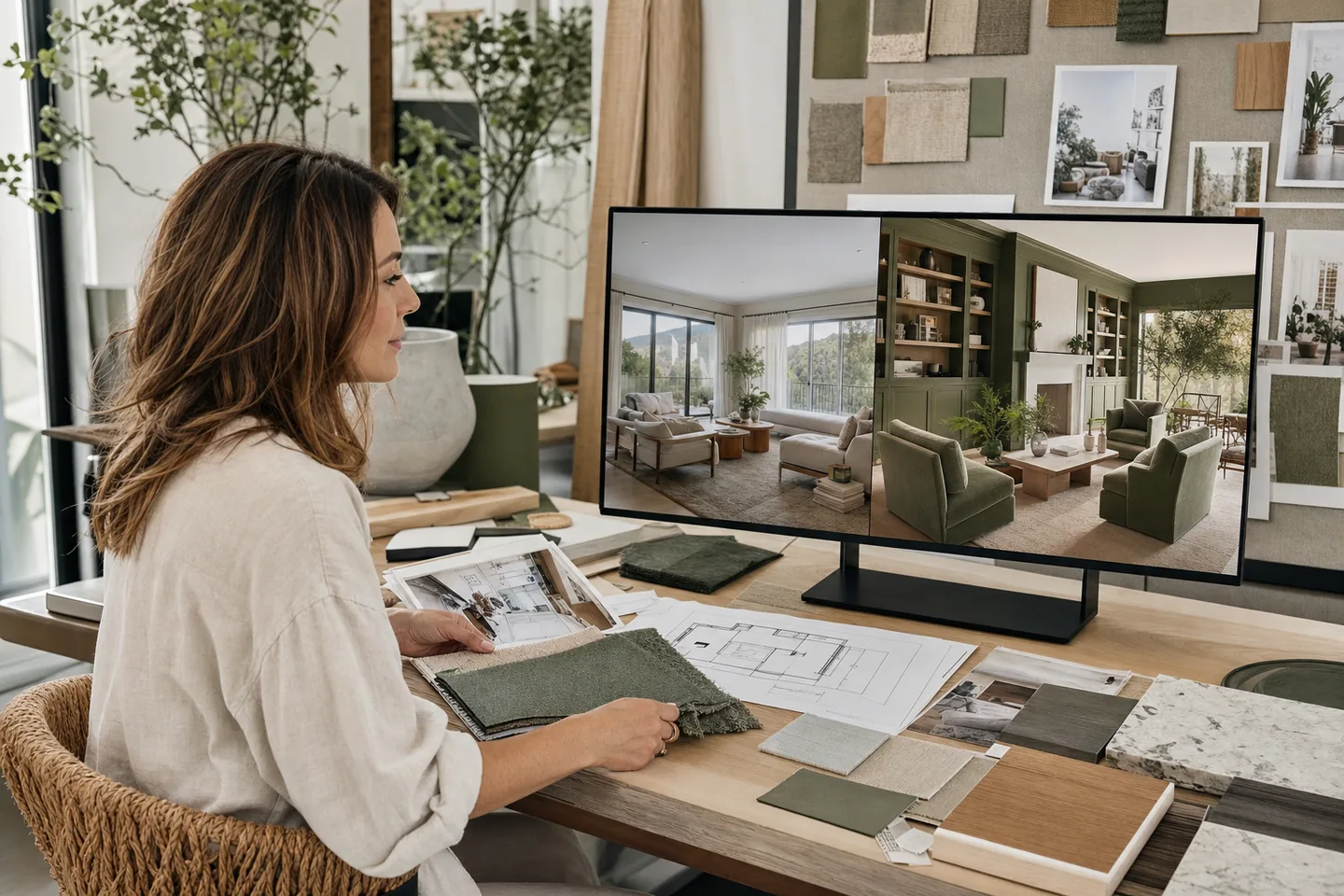
Will AI Replace Interior Designers? The Task-Level Answer
The phrase will AI replace interior designers treats interior design as one task, but the profession is a chain of different activities. A designer may interview a client, document a site, develop a concept, prepare layouts, compare finishes, coordinate lighting, review accessibility, communicate with contractors, revise a budget, and solve unexpected problems during installation. AI affects each activity differently.
Generative tools already make visual ideation faster. A homeowner can upload a room photo and test several styles with an AI room designer. A professional can generate mood directions, remove distracting objects from a reference photo, summarize meeting notes, or draft alternative presentation language. These uses reduce blank-page time and make early conversations more visual.
That does not make the output construction-ready. An appealing image may ignore door swing, electrical capacity, ventilation, fire safety, moisture, accessibility, lead times, maintenance, local codes, or the actual dimensions of furniture. It can also invent products and materials that are unavailable or unsuitable. A professional must verify what the image implies before anyone spends money.
The most realistic outcome is role redesign, not role deletion. Routine visualization becomes cheaper and faster, while human value shifts toward diagnosis, curation, technical coordination, trust, negotiation, and accountability. Designers who use AI well may handle more options and communicate decisions faster; designers who only sell generic mood images face more pressure.
Interior Design Tasks: AI Strengths and Human Responsibilities
This matrix shows why the answer is not a simple yes or no. AI can assist many tasks, but assistance is different from professional responsibility.
| Design task | What AI can do | What a designer must verify | Replacement risk |
|---|---|---|---|
| Mood boards and style concepts | Generate many color, material, and furniture directions quickly | Fit with the client's identity, existing architecture, budget, and long-term use | High automation, low need for manual production |
| Room-photo visualization | Create before-and-after concepts from an uploaded photo | Whether geometry, circulation, scale, windows, and fixed elements are represented honestly | High assistance, limited reliability |
| Space planning | Suggest layouts and organize options from stated constraints | Accurate field measurements, clearances, accessibility, code, and everyday behavior | Medium assistance |
| Material and product selection | Find visual matches and summarize product information | Durability, finish samples, availability, warranties, maintenance, and supplier accuracy | Medium assistance |
| Construction documents | Draft notes, schedules, and repetitive documentation | Technical accuracy, coordination, liability, and jurisdiction-specific requirements | Low replacement potential |
| Client and contractor coordination | Summarize communication and track open questions | Resolve conflicts, interpret priorities, negotiate trade-offs, and own final decisions | Very low replacement potential |
| Installation and site problem solving | Offer reference information or alternative ideas | Inspect actual conditions and respond to hidden, changing, or unsafe conditions | Very low replacement potential |
A Better Human-AI Interior Design Workflow
The strongest process gives AI a defined role instead of treating it as an autonomous designer.
1. Start with a verified brief
Document users, room functions, measurements, fixed elements, budget, timing, accessibility needs, maintenance expectations, and what must not change. AI prompts should come after these constraints are clear.
2. Use AI to expand options
Generate style directions, color families, lighting moods, layout hypotheses, or room-photo variations. Keep the outputs broad enough to compare, but label them as concepts rather than promises.
3. Curate instead of accepting
A designer removes attractive but impractical ideas, combines useful elements, checks scale, and explains why one option fits the client better than another. Curation is where experience becomes visible.
4. Rebuild the idea with real specifications
Translate the selected concept into measured layouts, sourced products, finish samples, lighting decisions, cost ranges, documentation, and trade coordination. Never specify a product simply because an AI image appears to show it.
5. Keep a human approval trail
Record assumptions, client approvals, substitutions, risks, and decisions. This matters when the project changes, a material is delayed, or an image has suggested something that cannot be built safely.
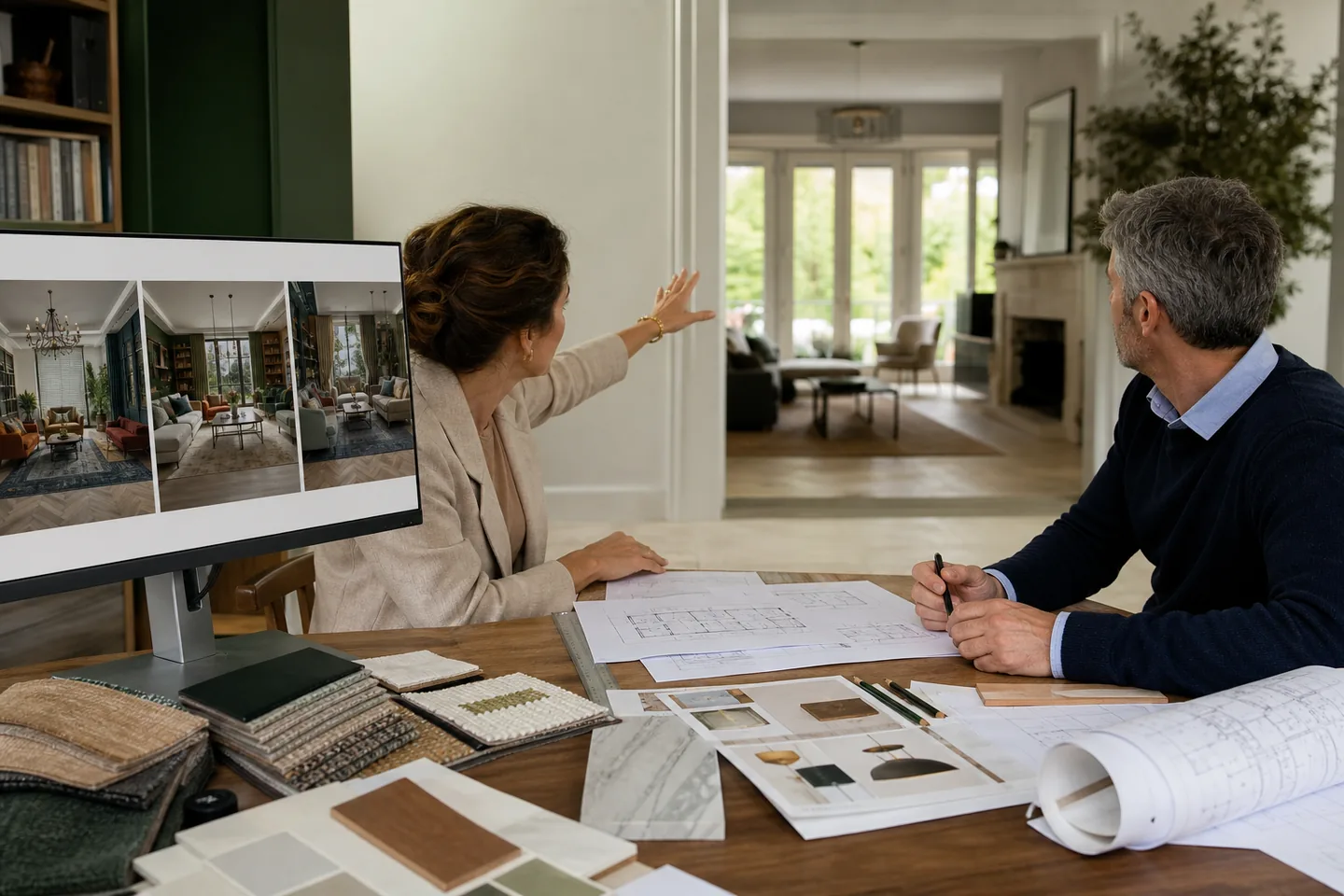
What Becomes More Valuable for Interior Designers
Client discovery and behavioral understanding
Clients rarely arrive with a complete brief. They may disagree about priorities, describe feelings instead of functions, or overlook habits that shape the room. Skilled designers uncover those needs through observation and conversation.
AI can organize answers, but it does not experience family routines, sensory preferences, cultural meaning, or the emotional tension behind a renovation decision.
Technical coordination and risk management
Design decisions interact with architecture, lighting, electrical work, plumbing, ventilation, acoustics, accessibility, procurement, and installation. The more complex the project, the less useful an unverified image becomes.
Interior designers add value by spotting conflicts early, communicating with specialists, and knowing when an engineer, architect, contractor, or code professional must be involved.
Curation, originality, and accountable taste
When anyone can generate hundreds of attractive rooms, quantity stops being a differentiator. The valuable skill is choosing a coherent direction and carrying it through details without producing a generic copy of the same trend.
A strong designer can explain why an option fits the place and the person, then defend that choice through budget changes and installation constraints.
Should Homeowners Use AI or Hire an Interior Designer?
Use AI alone for low-risk exploration: testing paint moods, comparing broad styles, imagining furniture arrangements, or preparing questions before a consultation. Our AI interior design prompts guide can help you describe the room more clearly, and the floor-plan workflow guide explains when a photo is not enough.
Hire a designer when the project includes structural changes, custom cabinetry, kitchens or bathrooms, lighting plans, accessibility, expensive purchasing, several contractors, strict deadlines, or decisions that are difficult to reverse. Professional help is also valuable when household members cannot agree or when the project has become too complex to manage confidently.
A hybrid approach works for many projects. Use AI to clarify preferences and compare early directions, then bring the shortlist, measurements, inspiration images, and concerns to a designer. This can make the first professional conversation more focused without pretending that concept images are finished plans.
How Designers Can Prepare for the AI Shift
Learn to direct and evaluate AI rather than competing with it on image quantity. Build repeatable workflows for briefs, prompt libraries, image review, product verification, privacy, and client disclosure. Keep the source photo, measured plan, and approved specification separate from generated concepts so the project record remains clear.
Strengthen the skills that are difficult to automate: site observation, interviewing, presentation, material literacy, detailing, procurement, budgeting, project coordination, and working with trades. These skills turn visual ideas into reliable spaces and are also the areas where clients most need accountability.
Be transparent. Explain when an image is AI-generated, what has not been verified, and which decisions still require measurement or specialist review. Designers who set honest boundaries can use AI as evidence of speed and exploration without weakening trust.
FAQ
Can AI replace interior designers completely?
No. AI can automate visual concepts, summaries, and repetitive production, but it cannot independently verify a physical site, accept professional liability, coordinate every trade, understand all client behavior, or guarantee that an image can be built safely.
Will AI take over interior design jobs?
AI will change job content and may reduce time spent on basic visualization or presentation production. It is more likely to reshape roles than eliminate the profession, increasing the value of technical, interpersonal, and project-management skills.
What interior design tasks are easiest to automate?
Mood boards, style variations, room-photo concepts, image cleanup, meeting summaries, first-draft copy, and repetitive option generation are relatively easy to accelerate with AI. Every output still needs review.
Is AI interior design accurate?
It can be visually convincing without being dimensionally or technically accurate. Treat generated rooms as concept images unless measurements, products, clearances, materials, and construction requirements have been independently verified.
Should interior design students still enter the profession?
Yes, if they are willing to combine design fundamentals with new tools. Students should learn space planning, materials, building systems, communication, and professional practice while also learning how to direct and audit AI output.
Authoritative References
- U.S. Bureau of Labor Statistics: Interior Designers - employment outlook and description of professional responsibilities
- O*NET OnLine: Interior Designers - task, skill, knowledge, and work-activity profile
- American Society of Interior Designers - professional context, practice resources, and industry guidance
- Autodesk AI and design resources - first-party context for AI-assisted design workflows
Use AI for Exploration, Not Unchecked Decisions
Upload a room photo to explore visual directions, then verify scale, products, materials, costs, and technical decisions before acting on the result.
Explore Room Concepts